





Key Takeaways
- POC, Prototype, MVP, and Pilot serve different purposes.
- Choose the right validation stage before investing in development.
- Validate progressively to reduce risk.
- An MVP is not a smaller version of your final product.
- A good development partner helps you validate before you build.
If you’ve spent any time talking to developers, investors, or accelerators, you’ve heard all four of these words.
MVP. POC. Prototype. Pilot.
They’re often used interchangeably. They shouldn’t be.
Each one describes a different stage of validation, a different type of output, a different level of investment, and a completely different question you’re trying to answer.
Getting them confused — or letting a vendor get them confused — is one of the most expensive mistakes an early-stage founder can make. We’ve seen founders commission a “prototype” when they needed a POC. Pay for an “MVP” when a prototype was the right tool. And build a “pilot” when the idea hadn’t been validated at all.
This article will fix that. For good.
The question each one answers
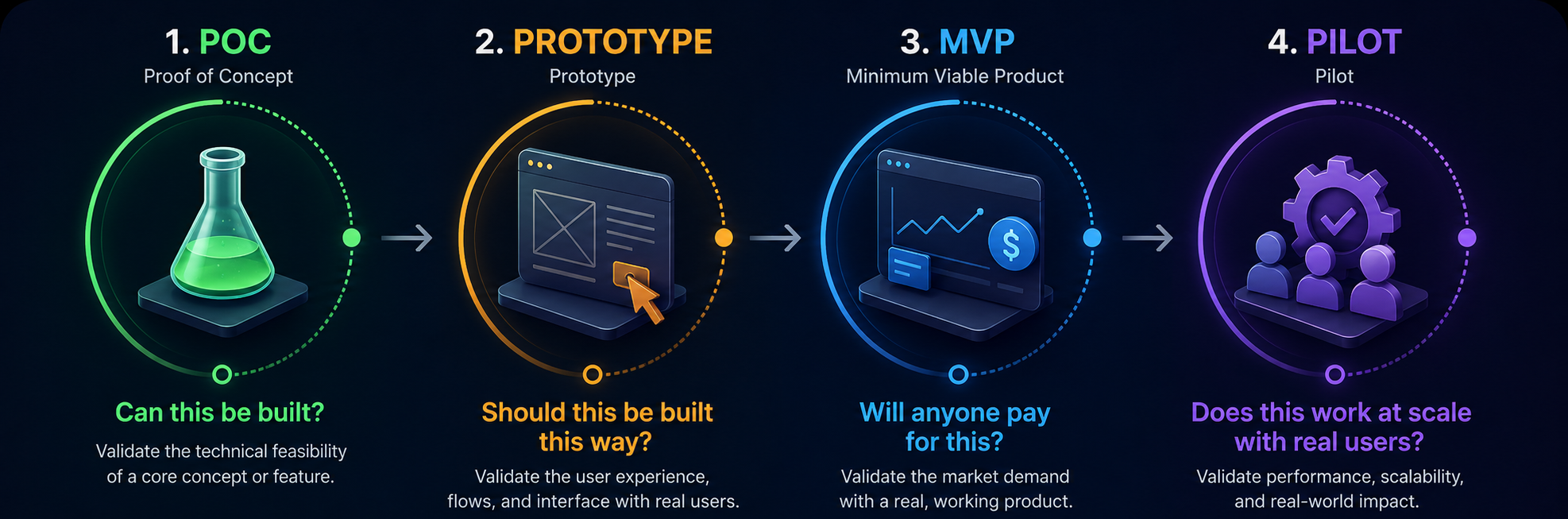
The cleanest way to understand the difference is to map each term to the question it’s designed to answer:
- Proof of Concept (POC): Can this be built?
- Prototype: Should this be built this way?
- MVP: Will anyone pay for this?
- Pilot: Does this work at scale with real users?
These are four fundamentally different questions. They require four fundamentally different types of work. And they sit in a natural sequence — though not every product needs to go through all four.
Proof of Concept — validating the technical assumption
A POC exists to answer one question: is the core technical concept feasible?
It is not a user-facing product. It is not designed to impress anyone aesthetically. It is a working demonstration that a specific technical approach functions as intended.
What it looks like in practice : A payments company wondering if they can build a fraud detection model in real time. A logistics startup testing whether their routing algorithm can process 10,000 addresses in under 2 seconds. A SaaS team wondering if a proposed API integration will work within their existing architecture.
None of these need a polished UI. They need proof that the engine works.
When to use it : When you have a technical hypothesis that your entire product concept depends on — and you haven’t proven it yet. Build the POC before committing to the full product.
What it is not: A POC is not something you show to end users. It is not a product. It is an experiment with a binary outcome: it works, or it doesn’t.
Typical timeline: 3–10 days
Typical output : A working demonstration of one technical function. Often rough, often internal-only.
Prototype — validating the user experience
A prototype answers a different question entirely: does this make sense to a human being?
Where a POC tests technical feasibility, a prototype tests experience. It is almost always a design exercise rather than an engineering one — a clickable representation of how the product will work, built without production code.
What it looks like in practice: A series of screens in Figma that a user can click through as if they were using the real product. The buttons appear to work. The flows feel complete. But underneath, there is no real software — just linked design frames.
When to use it: When you want to test your assumptions about user flow, interface logic, and experience before committing to building anything. Showing a prototype to 10 real users and watching them navigate it reveals more than six months of assumption-driven engineering.
What it is not: A prototype cannot be submitted to an app store. It cannot process real payments. It cannot connect to a live database. It is a simulation.
Typical timeline : 3–7 days
Typical output : A clickable Figma or InVision file. Sometimes a simple HTML mockup. Nothing that runs on a server.
MVP — validating the market
The MVP is the most misunderstood term in product development. It has been stretched to mean everything from “quick version” to “everything we plan to build but faster.”
The original definition, from Eric Ries’s The Lean Startup, is precise: the minimum viable product is the version of a product that allows a team to collect the maximum amount of validated learning about customers with the least effort.
The key word is minimum. Not minimum quality. Minimum scope.
An MVP is real, working software. It is not a prototype. It is not a beta. It is a production-ready product — but covering only the core use case that validates whether the fundamental value proposition is real.
What it looks like in practice: Airbnb’s first MVP was a website where the founders themselves photographed apartments and listed them manually. No automated onboarding. No complex search. Just a working proof that people would book a stranger’s home online.
Dropbox’s first MVP was a video. Not even software — just a demonstration of the concept that generated a waiting list of 75,000 people overnight.
When to use it: When you’ve validated the experience (prototype) and the technology (POC), and you’re ready to put something in front of real paying — or at least real using — customers.
What it is not: An MVP is not a rushed version of your full product vision. It is a deliberately scoped product built to answer one question: will real people use this and get value from it?
Typical timeline : 4–14 weeks depending on scope
Typical output : A production-deployed web or mobile application with one core user flow working end to end
Pilot — validating at scale
A pilot takes a validated MVP and deploys it in a controlled real-world environment with a defined user group, success metrics, and a specific time window.
What it looks like in practice: An enterprise software company deploying their tool to one department of 50 people before rolling out company-wide. A logistics startup running their routing algorithm for one city before expanding nationally.
When to use it: After your MVP has demonstrated real user value and you need evidence of scalability, reliability, or enterprise-readiness before committing to full rollout.
What it is not: A pilot is not a public launch. It is a structured experiment with a defined end point and clear success criteria agreed upon before it starts.
Typical timeline: 4–12 weeks post-MVP
Typical output: Performance data, user feedback, and a clear go/no-go decision for full deployment
The decision framework
Before you talk to any development team about building something, answer these two questions:
Is the core technology proven? If no — start with a POC. Is the user experience validated? If no — start with a prototype.
If both are answered yes — build your MVP. If your MVP has real users getting real value — consider a pilot before scaling.
If a vendor suggests jumping straight to an MVP without asking these questions, that is a signal. Good development partners help you build less, not more, until the fundamentals are validated.
Not sure what your business needs?
Book a free 20-minute consultation to discuss your goals and explore the best approach—no sales pitch, just practical advice.
Book Your Free Consultation